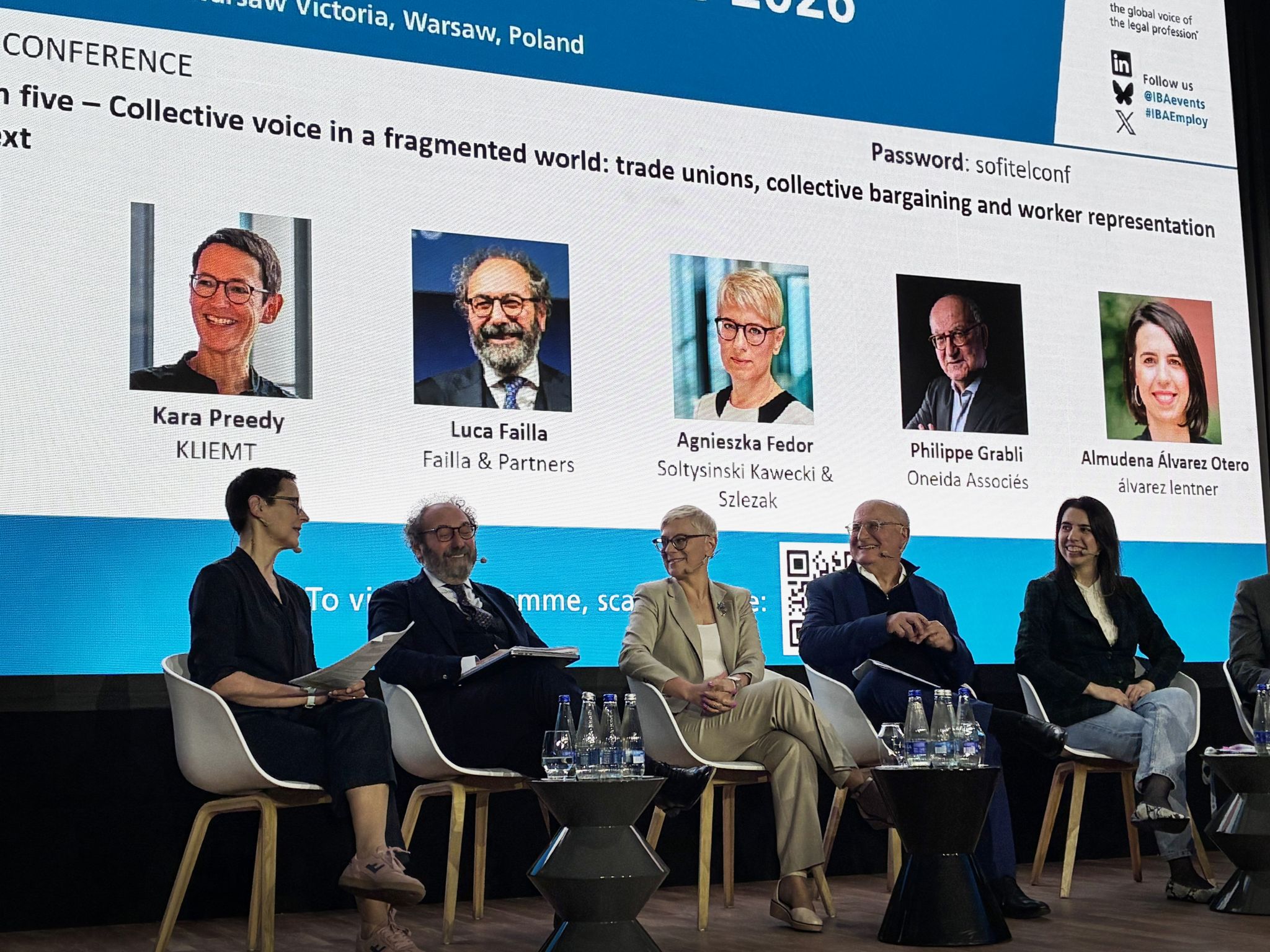
Social dialogue: towards a new era of employee representation?
A look back at the presentation by Philippe Grabli, Senior Partner at Oneida Associés (BU Conseil Oasys & Cie | Diot-Siaci), at the IBA Employment and Diversity Law Conference 2026 in April 2026 in Warsaw.
–
May 2026
–
At the IBA Employment and Diversity Law Conference 2026, held from April 22 to 24, 2026 in Warsaw, Poland, Philippe Grabli, Partner at Oneida Associés (BU Conseil Oasys & Cie | Diot-Siaci), spoke at the session dedicated to the transformations of collective employee representation in a rapidly changing global context.
As companies face profound changes in the world of work — the rise of artificial intelligence, new employee expectations, the hybridization of work models, value sharing, and economic and social tensions — traditional social dialogue models are being called into question.
In this interview, Philippe Grabli shares his analysis of the changes in employee representation, new forms of employee mobilization, and the challenges companies will have to face in the coming years.
How do you see the evolution of employee representation?
P.G. – Employee representation is increasingly taking on a multiform dimension: works councils and traditional unions, known as representative in France, are seeing their legitimacy attacked, with a plummeting number of members, which weakens them both financially and in terms of legitimacy. New forms are appearing, such as employee collectives that often only last the duration of a conflict, for example the controllers at SNCF, the “Yellow Vests,” employees close to civil society associations, particularly in environmental defense. This phenomenon of fractures within unions and the emergence of new forms of demands is occurring all over the world: in some companies in Poland, there can be up to 80 different unions!
How are companies reacting to this? What lessons should they learn from it?
P.G. – Some companies rejoice at the declining influence of unions; they forget that in many countries, unions are indispensable in negotiations. They would be better off reinvesting resources in employee relations, a subject that has been the victim of repeated budget cuts. Admittedly, management now has more processes and tools than in the past to hear the voices of their employees, via forums or surveys. They can thus identify sources of tension and dissatisfaction before they materialize into social conflicts. But this is not enough: training managers and Human Resources professionals, and even Employee Representatives, in employee relations to help them establish constructive social dialogue on the ground—and not just at the central works council or the group committee—should be the approach for most companies.
How do you see the future of employee relations?
P.G. – The number of socially sensitive situations can only increase with deindustrialization in Europe, the arrival of AI, and rising inflation worldwide. Companies must accept the need to invest in issues related to employee relations, to maintain team engagement and equip managers accordingly, otherwise they will lose them
The transformations of work and the ongoing economic changes are permanently reshaping the dynamics of social dialogue. Faced with more fragmented forms of representation and growing social expectations, companies will no longer be able to limit themselves to internal climate measurement tools or to centralized management of employee relations.
The challenge will now be to recreate spaces for local dialogue, invest in the training of managers and HR teams, and strengthen the ability to anticipate social tensions. In an environment marked by AI, deindustrialization, and inflationary pressures, the quality of employee relations becomes a strategic lever for stability, engagement, and sustainable performance.